A document-led investigation into a real Vancouver visit, a later trip that was canceled, and the records that have too often been treated as evidence of travel without proof someone arrived.
SOURCE-CONTROLLED ATLAS DOCUMENTED EVENTS & LIMITS UPDATED 10 OCT 2026 · SOURCE AND MEDIA CHECK
Investigative feature · The Living Library
The Vancouver dinner, the meeting that never happened, and the paperwork in between
The most consequential British Columbia record begins with an ordinary detail: a dinner reservation in a private room of a Yaletown restaurant. In March 2014, an organizer circulated a guest list that included Jeffrey Epstein among some of the most prominent names in technology. A schedule placed him in Vancouver that evening, and an email he sent the next day acknowledged the dinner. Two years later his staff tried to organize another Vancouver visit, this time with reserved conference space and meetings, before a contemporaneous cancellation redirected him to Washington.
Those records establish different things. The 2014 correspondence supports an actual visit and dinner attendance; the 2016 conference and hotel papers describe arrangements that cannot be turned into a completed journey. The distinction matters especially when the names of other invited people appear in the same files. An organizer's RSVP category is not an independently verified attendance register, and proximity to Epstein in a document is not evidence that another person took part in his crimes.
There is more here than a pin on a map. A university-related gift, an earlier private-aircraft itinerary involving Ghislaine Maxwell, and a later Canadian immigration refusal show how travel plans, institutional channels and official decisions intersected over more than a decade. This Atlas links those records to the public places they reference while keeping the still-missing evidence visible.
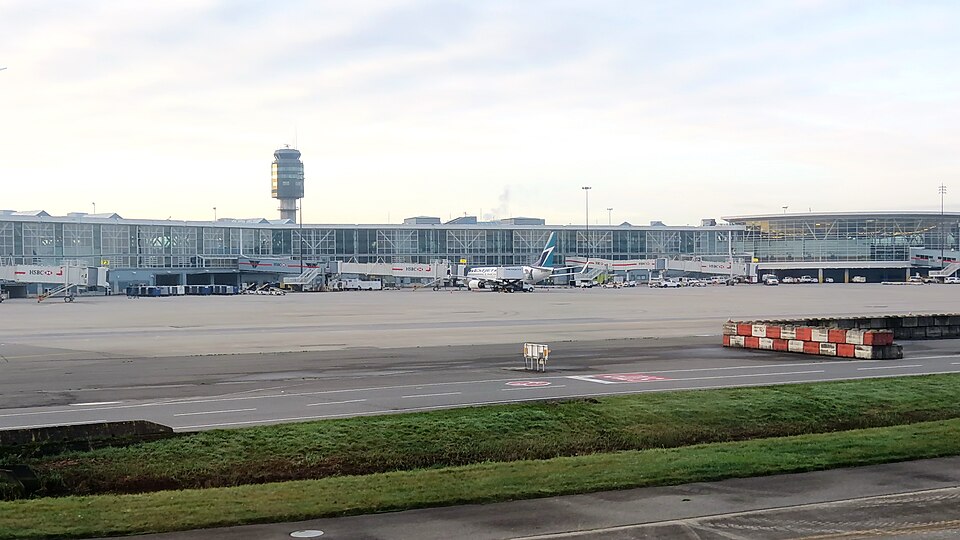
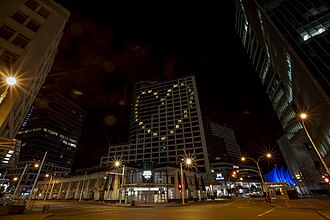
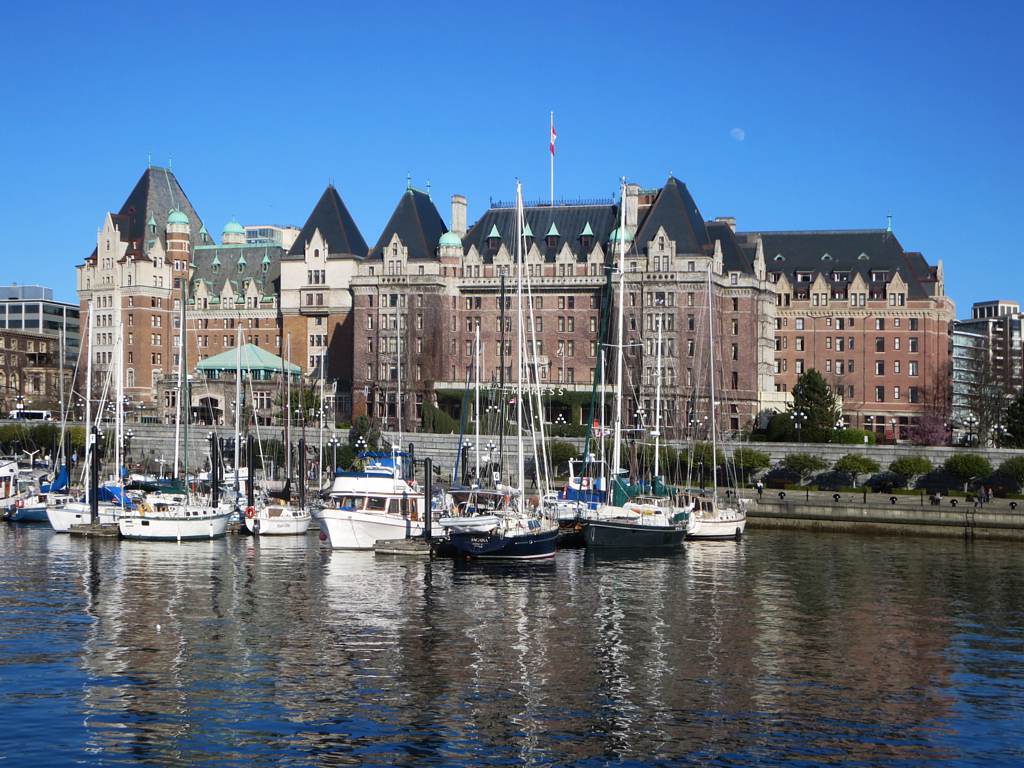
Vancouver International AirportContext for the 2014 movement records. Photograph does not document Epstein's flight. Original photograph and licence ↗Fairmont Waterfront2020 exterior photograph, unrelated to the planned 2016 gathering. GoToVan · CC BY 2.0 ↗Fairmont Empress, Victoria2014 exterior photograph; the 2005 itinerary lists planned lodging, not occupancy. David Stanley · CC BY 2.0 ↗
Inside the records
Follow the documents in sequence. Original release links open the U.S. Department of Justice archive when available; some government documents require an age-verification step. Text extraction and intermediary copies may contain transcription errors. Each section separates a planned activity from independently supported attendance or movement.
MARCH 2014 · VANCOUVER / YALETOWN
An invitation, a private room, and a reply the next afternoon
On February 25, 2014, literary agent and Edge organizer John Brockman sent an invitation for a dinner scheduled alongside the Vancouver TED gathering on March 17. He described a small, invitation-only event and asked recipients to keep the plans discreet. The dinner was eventually assigned to Blue Water Cafe at 1095 Hamilton Street in Yaletown. The correspondence identified a private dining room and circulated a working guest list. The document is valuable for what it says about the invitations, although it cannot establish everyone who was physically in the room.
That guest list categorized Jeffrey Epstein as confirmed and also named technology and media figures including Jeff Bezos, Sergey Brin, Larry Page, Yuri Milner, Jeff Skoll and Anne Wojcicki. Those are organizer-designated RSVP statuses, not an independently authenticated roll call. Other invitees were still awaiting responses, while several had declined. The record does not establish what the attendees discussed, what any individual knew about Epstein's conduct, or that anyone named in the invitation participated in a crime.
Epstein's own March 17 travel schedule adds unusual specificity. It proposed a 1:30 p.m. departure from his ranch, a 3:15 p.m. arrival in Vancouver, transportation organized through Griffin, and a reservation at the then-operating Four Seasons Vancouver at 791 West Georgia Street. At 7:45 p.m., the schedule listed Brockman's dinner in the restaurant's private room. Each hour is a planned itinerary time; the schedule is not a pilot log, hotel occupancy record, or record of admission by Canadian border authorities.
A different document advances the evidence beyond planning. In an email to Brockman on March 18, Epstein described the previous evening's dinner favorably and thanked him for including him. In a February 2018 follow-up, assistant Lesley Groff likewise referred to the March 2014 dinner as an event Epstein attended, while asking pilot Larry Visoski to confirm the flight details from logs. The contemporaneous participant email carries the stronger weight for dinner attendance; the later staff recollection helps explain why flight documentation was being sought, but is not itself a manifest.
The same March 17 schedule anticipated departure from Vancouver for Seattle on March 20. The separately indexed U.S. Customs and Border Protection record gives a concrete endpoint: Epstein entered the United States at Seattle–King County International Airport on March 20, 2014, with Vancouver International Airport listed as the departure point and general aviation as the carrier class. The arrival record does not establish the aircraft's complete route, the identities of other passengers, or the Canadian officer's earlier admission decision. Its original page-image authentication remains an open source-quality check.
A documented 2014 Vancouver presence and a participant's account of dinner attendance, with an independent U.S. return crossing. It does not establish that each named invitee attended, that an unlawful act happened at the dinner, or that Canada approved entry on any specific terms.
FEBRUARY 2016 · FAIRMONT WATERFRONT
A room was booked for meetings. Then the visit was cancelled.
The 2016 paper trail is more elaborate than a single hotel reservation. A January invitation from Brockman proposed another Edge dinner at Blue Water Cafe for February 17. On February 9, Epstein's assistant told the organizer he intended to attend. The response records an RSVP, not the person's eventual arrival. At the same time, the office was negotiating where Epstein would stay and whom he hoped to meet.
On February 10, Groff wrote to the office of physician Peter Attia about a possible meeting during the Vancouver trip. She described a conference room at the Fairmont Waterfront booked under Enhanced Education, the organization named in the released event papers. She also reported holding a Hyatt suite as an alternative accommodation, while the Fairmont was being considered. Follow-up correspondence discussed a proposed February 17 meeting and specified the Cheakamus Room on the hotel's concourse level; according to the email, the hotel's reader board would use the Enhanced Education name.
The hotel's revised February 12 banquet orders make the preparations tangible. They describe meeting-room setups and an expected group of approximately twelve, with continental breakfast, buffet lunch, and reception periods. The orders identify the Cheakamus Room and the same corporate booking name. They are instructions for service and contracted arrangements, however, rather than completed service records or a verified list of people who occupied the room. The distinction is reinforced by the different dates shown across the event-order copies.
On February 16, Groff sent a separate message to Joi Ito announcing that Epstein was cancelling the Vancouver trip and travelling to Washington, D.C., instead. A card statement with Fairmont Waterfront merchant entries is not enough to undo that contemporaneous cancellation: a booked event can generate charges even when its principal traveller does not arrive. The publicly searchable statement text is too ambiguous to establish the final amount, whether charges were duplicated, or what was refunded. Nor does the cancellation establish that every other planned meeting or dinner was called off.
A substantial program of arrangements, named meeting correspondence and a cancellation of Epstein's travel. It does not establish that Epstein occupied the meeting room, checked into either hotel, met Attia in Vancouver, or attended the proposed February 17 dinner.
2011 · UBC / SEA AROUND US
A $25,000 donation crossed an institutional boundary
The University of British Columbia connection is financial rather than geographical evidence of a personal visit. Reporting by the independent campus newspaper The Ubyssey documents a US$25,000 donation in 2011 from Epstein's Enhanced Education foundation to the American Foundation for the University of British Columbia, supporting the university-based Sea Around Us fisheries research project. That American foundation is a separately constituted U.S. charity used to process gifts for the Canadian institution.
In its statement to the campus paper, UBC said neither the documentation accompanying the gift nor its due diligence identified the donor's relationship to Epstein. A university representative said the institution and its foundation had not interacted with him, and that the donation would not have been accepted if the connection had been known. The reporting therefore raises a concrete question about donation screening and institutional disclosure while supplying no evidence that Epstein visited the UBC campus or that the researchers knew the source of the funds.
The later 2016 Vancouver meeting reservation under the name Enhanced Education shows that the same name appears in a different class of document, this time a hotel order. It would be misleading to combine those references into proof that the university funded the meeting or that the events were connected beyond their common donor-associated name. The Atlas keeps the funding and hospitality records as distinct transactions.
The Victoria itinerary was about Maxwell and Waitt
The earliest British Columbia travel documents in this collection concern Ghislaine Maxwell and technology entrepreneur Theodore Waitt, rather than Jeffrey Epstein. A six-page TAG Aviation itinerary prepared ahead of departure scheduled a private aircraft through Vancouver on June 29, a Vancouver–Victoria leg on June 30, and a Victoria–Teterboro departure on July 2. The Fairmont Empress appears as intended Victoria lodging. Epstein is not named as a passenger on the relevant listed legs.
Because this is a predeparture itinerary, it does not on its own establish that each flight operated as planned, who ultimately boarded, or whether the named hotel reservation turned into a stay. The distinction is important when comparing the British Columbia evidence against Epstein's historical movement archive: an aircraft itinerary involving people connected to him should not silently become an Epstein flight or a proven local visit. No offence in Victoria or Vancouver is inferred from the booking record.
Canada's written refusal answers a different question
On April 4, 2018, Canada's Consulate General in Los Angeles refused Epstein's application for a temporary resident permit. The letter cited criminal inadmissibility under section 36(2)(b) of the Immigration and Refugee Protection Act and said the grounds offered were insufficient to justify a permit. It expressly instructed him not to visit Canada without first receiving written permission from an immigration officer.
The decision is consequential evidence of Canada's position on that 2018 application. It is not a decision about the March 2014 trip, and it does not supply the missing Canadian border record for that earlier journey. Comparing the two without their dates or administrative contexts would create a false chronology. The Atlas therefore maps the refusal as an administrative record rather than as another visit to British Columbia.
A Canadian admission record from March 2014 could clarify how Epstein entered the country and under what authorization. The signed original passenger manifest and aircraft log could settle the disputed March 2013 Vancouver movement rather than relying on conflicting secondary transcriptions. A final hotel folio, settled card accounting and any service-cancellation records could explain the February 2016 Fairmont charges. The original communications regarding a Prince Rupert port visit or Vancouver Island property inquiry remain leads until their wording can be checked directly; neither one currently establishes Epstein's presence or a property acquisition.
The questions are bounded and testable. This investigation should change when a new original record is authenticated, not when a searchable document happens to contain a British Columbia place-name. The province-wide map below therefore has intentionally sparse verified locations outside southwest British Columbia. Unmapped regions are gaps in the present evidence, not conclusions about what could never have happened there.
How to use this Atlas
Each record below includes the document's date, status, associated public location, and what the source fails to establish. A reservation is labelled as a plan; a participant's follow-up is identified as firsthand correspondence; government border and immigration records are attributed to the agency that issued them. The underlying documents remain available through the source links for independent review.
Map zoom shows geographic context. Documentary records are concentrated in the southwest; regions without verified records remain visible.
Loading map tiles. The source-linked chronology remains available without a map connection.
Markers indicate the locations of documented records; they do not necessarily indicate that Epstein or another named person was physically present. Confirmed cross-border departure context is distinguished from planned flights; any connecting line is schematic, not a flown track.
The records, in date order
Some entries include historical or later photographs of public places for orientation. They do not depict or verify the event described. Creator, date, source and licence accompany each image in its record details. Images are served through the Library when available; a source-host fallback remains in place.
Evidence detail
Select a record
The full date, evidence class, document reference and interpretive boundary will appear here. You can use the list, a map pin or keyboard navigation.
Unresolved records
Questions the documents have not settled
12014 government-indexed U.S. re-entry from Vancouver
2travel periods with unresolved movement or occupancy: 2005 and 2013
2016Vancouver visit cancelled; financial records separately indexed
What the documents still cannot tell us
Each event includes its source reference and explains the limits of the evidence. U.S. CBP text for March 20, 2014 documents travel out of Vancouver; this does not resolve Canada’s earlier admissibility decision. The 2005 TAG legs are scheduled, the disputed 2013 leg is withheld, and the 2016 Vancouver visit was cancelled.
The original handwritten 2013 passenger manifest remains disputed, the 2016 hotel charge amounts need checking against the scanned statement, and Canada's earlier immigration decision is not in the available public file. Northern British Columbia and provincial Interior searches did not produce comparable verified source events in the current research collection. A missing marker means no supported atlas entry yet, not that nothing occurred there.
Map boundaries: the connected display attempts official B.C. geospatial data; offline coordinate plots are expressly schematic. B.C. boundary dataset ↗ · Open Government Licence ↗. Contains information licensed under the Open Government Licence – British Columbia when displayed.
Methodology
Contemporaneous itinerary or room order = planning, not physical presence. Participant correspondence may establish an account of attendance, not every item in a guest list. Merchant statement = accounting record, not hotel occupancy. Immigration refusal = decision, not an entry. Unverified private-property allegations are never pinned. Click the underlying document before drawing conclusions.